
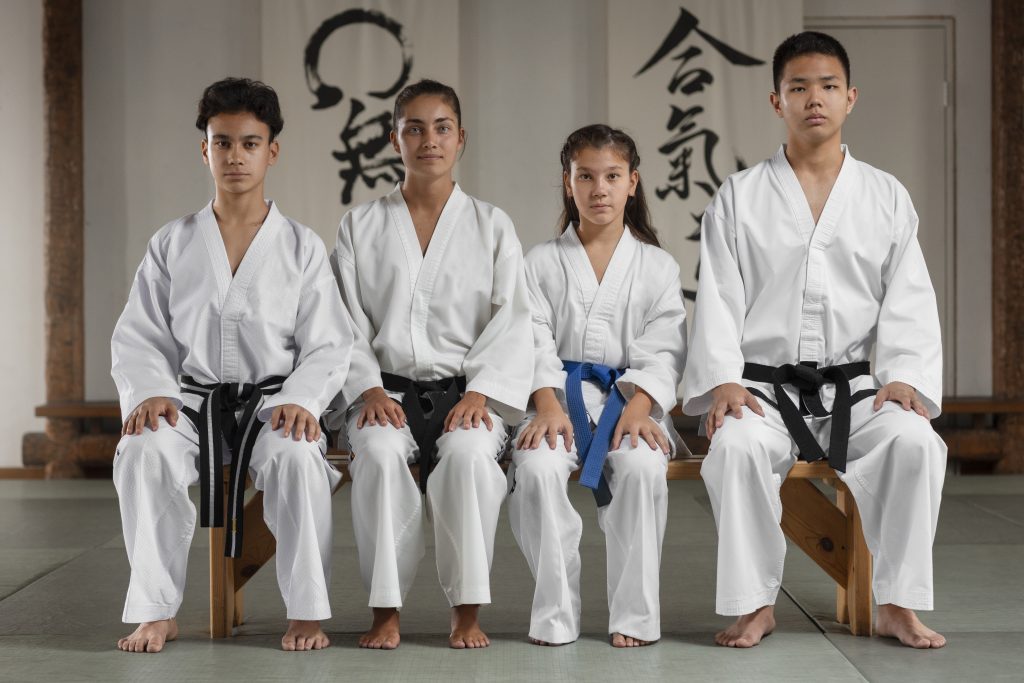
Introduction to BJJ Belts
BJJ belts are more than colored fabric tied around your waist — they represent skill, discipline, mat time, and personal growth in Brazilian Jiu Jitsu. If you’ve ever walked into BJJ Society in Gilroy and looked up at the belts tied around the waists of upper belts on the mat, you’ve probably wondered — what does it actually take to get there?
The Brazilian Jiu Jitsu belt system is one of the most respected ranking structures in all of martial arts. And for good reason. Unlike a lot of disciplines where you can test your way to a new rank, earning BJJ belts requires real skill, real mat time, and real performance against real people who are actively trying to submit you.
Whether you’re on day one at BJJ Society or you’ve been training for a year and just got your first stripe, this guide breaks down everything you need to know about BJJ belts — from white belt all the way to black belt and beyond.
Brazilian Jiu Jitsu belts aren’t just fabric. They represent:
- Skill progression
- Technical knowledge
- Mat experience
- Personal growth and discipline
Here’s the thing that makes BJJ different from most martial arts: your instructor isn’t promoting you because you passed a test on a Saturday afternoon. They’re promoting you because they’ve watched you roll, watched you struggle, watched you grow — week after week, month after month.
At BJJ Society Gilroy, Coach Jerry takes promotions seriously for exactly this reason. A belt here means something.
The IBJJF graduation system provides widely recognized guidelines for belt progression and minimum promotion standards in Brazilian Jiu Jitsu.
Overview of All BJJ Belt Ranks
The adult BJJ belt system has five main ranks:
- White Belt
- Blue Belt
- Purple Belt
- Brown Belt
- Black Belt
Beyond black belt, there are also Coral Belt, including Red/Black and Red/White, and Red Belt — reserved for those who’ve dedicated their lives to the art.
Each one is a real milestone. None of them come easy. The Brazilian Jiu Jitsu ranking system includes adult ranks from white through black, with coral and red belts representing advanced lifetime achievement in the art.
Focus: Survival and fundamentals
Typical Duration: 1–2 years
Everyone starts here — literally everyone, no matter your athletic background or size. At white belt, the goal isn’t to look good. The goal is to survive.
At BJJ Society Gilroy, our white belt classes are built around exactly this: helping new students learn the basic positions, including guard, mount, and side control, fundamental escapes, and their first submissions — without feeling completely overwhelmed.
If you’re brand new and want to experience the first step in the BJJ belts journey, you can start with a free first class at BJJ Society.
Don’t be discouraged if you’re getting tapped out constantly. That’s normal. Every black belt in the room was once a white belt who kept showing up.
Blue Belt — The Foundation Stage
Focus: Understanding and control
Typical Duration: 2–3 years
Blue belt is where things start to click. You stop just reacting and start actually thinking on the mat. You develop your own game — techniques that work for your body and your style.
At this stage, you can hold your own against beginners and start building real confidence. You also hit your first big mental test: the “blue belt blues.” A lot of people quit at blue belt, which is why it’s considered one of the hardest BJJ belts mentally.
Don’t be one of them. The students who push through this phase at BJJ Society are the ones you’ll see on the mat for years to come.
Purple Belt — The Development Stage
Focus: Strategy and creativity
Typical Duration: 2–4 years
Purple belt is where BJJ gets really fun. You’re no longer just surviving or building — you’re creating. Chaining techniques together, developing your own style, and starting to help lower belts find their footing.
Purple belts at BJJ Society often take on informal mentorship roles, and that’s no accident. Teaching is one of the fastest ways to deepen your own understanding of the art.
Brown Belt — The Advanced Stage
Focus: Precision and mastery
Typical Duration: 1–3 years
By brown belt, you’re operating at a high level. The focus shifts from learning new techniques to perfecting the ones you have — eliminating the small errors and tightening everything up.
Brown belts at BJJ Society are trusted training partners for everyone on the mat. If you’re rolling with a brown belt, pay attention. There’s a lot to learn just from feeling how they move.
Black Belt — Expert Level
Focus: Mastery and teaching
Time to Black Belt: Typically 8–15 years
This is the one everyone thinks about when they start BJJ. And yes — it takes a long time. Most people spend 8 to 15 years reaching black belt, which is exactly why it carries so much weight.
At BJJ Society Gilroy, earning your black belt means Coach Jerry has watched you grow from a nervous white belt into someone with deep technical knowledge, genuine leadership on the mat, and a commitment to the gym and the art.
It’s not just a rank — it’s a relationship built over years.
Red & Coral Belts — Mastery and Legacy
Beyond black belt, there are ranks most practitioners will never reach — and that’s okay:
-
- Coral Belt, Red/Black and Red/White: Awarded after decades of dedication at the highest levels of the sport
-
- Red Belt: Reserved for the pioneers and legends of BJJ — the Gracies and those who shaped the art itself
These belts represent a lifetime devoted to Brazilian Jiu Jitsu.
How Long Does It Take to Progress Through BJJ Belts?
Here’s a realistic timeline for adult belt progression:
-
- White to Blue: 1–2 years
-
- Blue to Purple: 2–3 years
-
- Purple to Brown: 2–4 years
-
- Brown to Black: 1–3 years
Your total time depends a lot on how often you train, whether you compete, and how intentional you are about improving. At BJJ Society Gilroy, students who train consistently 3–4 times per week tend to see steady, meaningful progress.
It’s not a race — but showing up matters more than anything else.

Kids vs. Adult Belt Systems
If you’re signing your child up at BJJ Society, the kids’ belt system works a little differently. It includes more colors — grey, yellow, orange, and green — which are designed to reward progress more frequently and keep young students motivated.
Once a student turns 16, they transition into the adult belt system. We work closely with parents and young athletes to make that transition feel smooth and encouraging.
The Gracie Jiu-Jitsu ranking system also gives helpful background on how youth and adult belt structures differ across Brazilian Jiu Jitsu traditions.
Tips to Progress Faster Through BJJ Belts
Want to move through the BJJ belts with purpose? Here’s what actually works:
-
- Train consistently — 3 to 5 times per week if you can
-
- Focus on fundamentals — flashy techniques mean nothing without a solid base
-
- Roll with higher belts — it’s uncomfortable, but it’s where you grow the fastest
-
- Compete — even if you lose, competition sharpens everything
-
- Take notes and review — what worked? What got you submitted?
Progress in BJJ isn’t just about time on the mat — it’s about intentional effort every single session. Coach Jerry and the team at BJJ Society Gilroy are here to help guide that process for every student, at every level.
If you’re ready to train consistently, view our Brazilian Jiu Jitsu class schedule and find a class that fits your routine.
Final Thoughts
BJJ belts are not just rankings — they are milestones in your personal journey. Every belt tells a story: the early sessions where nothing made sense, the rolls that humbled you, the breakthroughs that kept you coming back.
At BJJ Society in Gilroy, we’ve watched students walk through our doors as nervous beginners and grow into confident, skilled practitioners who give back to the community they trained in. That journey is what BJJ is really about.
Whether you’re just getting started or you’ve been on the mats for years, we’d love to be part of your story.
Come train with us. The mats are waiting.
Frequently Asked Questions
How many belts are there in Brazilian Jiu Jitsu?
There are five main adult belts: white, blue, purple, brown, and black — plus the advanced coral and red belts for long-term practitioners.
How long does it take to get a black belt in BJJ?
On average, 8 to 15 years, depending on your training consistency and skill development.
Is BJJ the hardest belt system to earn?
Many martial artists and coaches consider it one of the most rigorous, because promotions are based on performance rather than testing alone.
Can you skip belts in BJJ?
No. Belt progression is linear. Skipping belts is essentially unheard of in legitimate BJJ gyms.
What is the hardest belt in BJJ?
Blue belt tends to be the hardest mentally — the dropout rate at this stage is high. Pushing through is what separates long-term practitioners from those who quit.
Do stripes matter in BJJ?
Yes — stripes mark your progress within a belt and give your instructor a way to recognize development between promotions.
How often do you get promoted in BJJ?
Typically every 1 to 3 years, depending on the belt level and your individual progress.